Tuesday, October 01, 2013

The Savvy Reader Book Club Choices for October

The Savvy Reader Book Club is an online nonfiction book club created for the serious reader.  At the beginning of each month I select one or two books then host discussion posts covering the books throughout the month.  If you write a blog post about one of my selections I will be happy to include its link in my final post.

The Savvy Reader book club selections for October are:

Andrew Hacker and Claudia Dreifus book Higher Education?: How Colleges Are Wasting Our Money and Failing Our Kids---and What We Can Do About It

  
I decided to choose this book after talking to a recent college grad who after spending over $100,000 on a fashion merchandising degree can only find employment as a retail associate; a job that does not require a 4-year degree. This book promises to expose the truth about what is wrong with higher education and is guaranteed to provide interesting conversation.
 
I am also selecting Tina Fey's book Bossypants


I chose this book after learning it was the best book Sheryl Sandberg read last year. After reading a depressing book like the one above we will most likely be ready for a funny book. I've read mixed reviews about this book though.  Some reviewers have found it hilarious while others thought it wasn't funny at all.  Please join me if you would like to find out for yourself.   
 
Have you read either of these books? If so what were your thoughts?  Be sure to stop back in throughout the month to participate in the discussions. 
 
Please Note, I am an Amazon Affiliate

Monday, September 30, 2013

Final Thoughts on Sheryl Sandberg's Book Lean-in

This month The Savvy Reader Book Club read Sheryl Sandberg’s book Lean In: Women, Work, and the Will to Lead. Today I am sharing my final thoughts on this book. Previous discussions included What does "lean-in" mean for you?, When Taking a Pay-Cut is a Good Career Move, Sheryl Sandberg's Advice on How to Get Hired and Receiving a Job or Promotion Because You Are a Woman.

As you may recall I put-off reading this book because of the numerous negative reviews I'd read on-line; I thought it wouldn't be worth my time.  Was I wrong.  This book is the best career advice book I've read in years.  Here are a few additional career lessons from the book I didn't cover in previous posts:

Don't ever ask someone if they are your mentor:
This question is a total mood killer.  If someone has to ask the question, the answer is probably no. When someone finds the right mentor it is obvious.  (Pgs. 65-66)

Also a note from my experience, don't hand your business card to someone immediately upon meeting them with no additional conversation.  I can guarantee that business card will end up in the garbage.

On negotiation:
The goal of successful negotiation is to achieve our objective and continue to have people like us.  Professor Riley Bowles believes that women can increase their chances of achieving a desired outcome by doing two things in combination.  First, women must come across as being nice, concerned about others, and "appropriately female."

Sheryl advises many women to negotiate rather than accept the original offer. By doing so, women position themselves as connected to a group and not just out for themselves; in effect they are negotiating for all women.  Whenever possible, women should substitute "we" for "I."

According to Bowles, the second thing women must do is provide a legitimate explanation for the negotiation.  Men don't need to do this.  (Pg. 47)

What can we do to change social norms:
Too many work standards remain inflexible and unfair, often penalizing women with children.  Too many talented women try their hardest to reach the top and bump up against systemic barriers.  So many others pull back because they do not think they have a choice.  All of this brings me back to Leymah Gbowee's insistence that we need more women in power.  When leadership insists that these policies change they will.  Google put in pregnancy parking when I asked for it and it remains there long after I left.  We must raise both the ceiling and the floor. (Pg. 169)

Bottom line:
I think Sheryl Sandberg 's book Lean In: Women, Work, and the Will to Lead would make a great graduation gift in addition to being an excellent choice for any career centered book club.

 
If you read this book what did you think?

Please Note, I am an Amazon Affiliate

 
Young Finances

Wednesday, September 25, 2013

Receiving a Job or Promotion Because You are a WOMAN

This month The Savvy Reader Book Club is reading Sheryl Sandberg’s book Lean In: Women, Work, and the Will to Lead. Today is the forth in a series of posts I am writing though out the month inspired by Lean in. Previous posts discussed What does "lean-in" mean for you?, When Taking a Pay-Cut is a Good Career Move and Sheryl Sandberg's Advice on How to Get Hired.

Today I would like to talk about receiving a job or promotion because you are a woman.

When Sheryl was named the Treasury Department's chief of Staff in 1999, several people remarked to her:
"It must have helped that you were a woman." (Pg. 144)
Note there was no affirmative action for woman at the Treasury.

Oh my gosh! People have said something similar to me.  When I was in school studying to be a CPA more than one person told me I would have no trouble finding a job when I finished because "I was a woman."

Not even two weeks ago, a male I know who works for a fortune 500 company, told me the only way you can be promoted today in his division was to be a minority female. Seriously, I can't imagine promotions are awarded to minority females over men just because of gender or race.

It was conversations like these that inspired Sheryl to begin talking about women in the workplace. Here is a quote from her very first talk on this subject:
I began my talk by explaining that in business we are taught to fit in, but that I was starting to think this might not be the right approach.  I said out loud that there are differences between men and women both in their behavior and in the way their behavior is perceived by others.  I admitted that I could see these dynamics playing out in the workforce, and that, in order to fix the problems, we needed to be able to talk about gender without people thinking we were crying for help, asking for special treatment, or about to sue.  (Pg. 145)
Have you ever been told you or someone else received a job or promotion because of gender?  How do you think we can change these stereotypes?

Sunday, September 22, 2013

Sherl Sandberg's Advice on How to Get Hired

This month The Savvy Reader Book Club is reading Sheryl Sandberg’s book Lean In: Women, Work, and the Will to Lead. Today is the third in a series of posts I am writing though out the month inspired by Lean in. Previous posts discussed What does "lean-in" mean for you? and When Taking a Pay-Cut is a Good Career Move.

Today I would like to highlight Sheryl Sandberg's advice on how to get hired:

Sheryl had received a phone call from Lori Goler, a highly regarded senior director of marketing at eBay.  Lori was calling to ask Sheryl for a job at Facebook.  Instead of telling her all of the things she was good at and all of the things she would like to do at Facebook, Lori asked:
"What is your biggest problem, and how can I solve it?"
Sheryl's jaw hit the floor.  She had hired thousands of people over the previous decade and no one had ever said anything remotely like that.  Sheryl admitted her biggest problem was recruiting.  She hired Lori to solve it. (Pg. 54)

When I was interviewing for my current position I asked my future boss, "What do you foresee as your biggest project for the coming year."  He answered with "We have a big project in the works but I can't discuss it because it is not public knowledge."  My company was in the process of buying out a competitor. 

I like Lori's question much better:

It gives you an opportunity to ask for a specific job function or task while possibly providing the interviewer with a mental picture of you performing it.  This could give you an edge-up in the hiring process.

It also could provide you with insight into what is really going on at this company.  If their biggest problem is needing help securing financing - they have cash flow issues. Needing help with recruiting or retention could mean fast growth or low morale.  A paper flow or heavy work load problem may mean they are understaffed or mismanaged. You can then ask yourself is this a problem I want to help fix.

This post was inspired by Catherine Gacad who left a comment on my post What does "lean-in" mean for you? stating asking a potential employer, "What is your biggest problem, and how can I solve it? is the best interview advice she has ever heard.

What is the best interview advice you've been given?
Please Note, I am an Amazon Affiliate

Sunday, September 15, 2013

When Taking a Pay-Cut is a Good Career Move

This month The Savvy Reader Book Club is reading Sheryl Sandberg’s book Lean In: Women, Work, and the Will to Lead. Today is the second in a series of posts I will be writing though out the month inspired by Lean in. Last week we discussed What does "lean-in" mean for you?

Today I want to share what may have been my biggest career mistake:

In the chapter, “It’s a Jungle Gym, Not a Ladder” Sheryl Sandberg introduces the metaphor coined by Pattie Sellers “Careers are a jungle gym, not a ladder.” It implies the former career model of spending your entire career at one company continuously progressing up the ladder (while staring at the butt of the person above) no longer applies to most workers. Instead today’s career path is more like a jungle gym. Sheryl writes:
There’s only one way to get to the top of a ladder, but there are many ways to get to the top of a jungle gym. The jungle gym model benefits everyone, but especially women who might be starting careers, switching careers, getting blocked by external barriers, or reentering the workforce after taking time off. The ability to forge a unique path with occasional dips, detours and even dead ends presents a better chance for fulfillment. Plus, a jungle gym provides great views for many people, not just those at the top. (Pg. 53)
Sheryl has seen both men and women miss out on great opportunities by focusing too much on career levels.

This message really hit home when Sheryl writes about her friend who after working as a lawyer for four years realizes instead of shooting for partner she’d rather join a company in a sales or marketing role:
One of her clients was willing to hire her in this new capacity but wanted her to start at the ground level. Since she could afford the temporary pay cut, I urged her to make the jump, but she decided against taking a job that put her “back four years.” I understood how painful it was for her to lose hard-earned ground. Still, my argument was that if she was going to work for the next thirty years, what difference does going “back” four years really make? If the other path made her happier and offered her a chance to learn new skills, that meant she was actually moving forward. (Pg. 61)
I had spent years working full-time as a staff accountant while taking the courses I needed to sit for the CPA exam in my spare time. After I passed the exam I began searching for a new job that would utilize my new certification and pay me a larger salary. I talked to one of my former classmates who had been hired by a local CPA firm. She offered to set up an informational interview for me with a partner at her firm to discuss potential job opportunities. She did say I would most likely have to take a significant pay-cut if I were hired as an entry-level accountant at her firm. Since I was looking for an increase in pay not a decrease, I decided to pass on the informational interview. I then proceeded to not send out a single resume to an accounting firm. Instead I went on to work as a manager in an accounting department at a medium-sized company in a dying industry.

Sheryl has learned from her own experience the only criterion that mattered when picking a job was – fast growth. When companies grow quickly, there are more things to do than there are people to do them. When companies grow more slowly or stop growing, there is less to do and too many people to not be doing them. Politics and stagnation set in, and everyone falters.

Another aha moment – I picked this job:
I have always felt I worked at my current job because they were the only company that offered me a job, but while reading Lean in I realized I picked this job. I consciously chose not to pursue a career with an accounting firm. I listened as my current boss informed me the hours were long and the money was tight at his company. Later he would joke I was the only one who came back for a second interview.

I suffered from imposter syndrome – this is a phenomenon where capable people are plagued by self-doubt and is also mentioned in the book. I was  risk averse and terrified I was not qualified to perform a job that was too far out of my comfort zone. 

Sheryl writes about this too:
One reason women avoid stretch assignments and new challenges is that they worry too much about whether they currently have the skills they need for a new role. This can become a self-fulfilling prophecy, since so many abilities are acquired on the job. An internal report at Hewlett-Packard revealed that women only apply for open jobs if they think they meet 100 percent of the criteria listed. Men apply if they meet 60 percent of the requirements. This difference has a huge ripple effect. Women need to shift from thinking “I’m not ready to do that” to thinking “I want to do that – and I’ll learn by doing it.” 
Wow what an eye-opener. I can’t help but wonder where my career would be if I had leaned into a career as a CPA – pay-cut and all – rather than picking a job in another dying industry because that was what I was familiar with.

I have come to the conclusion this book should be given to every women upon graduation. 

Would you consider taking a pay-cut if it meant advancing your career in the long-run? What was your biggest career mistake?


Please Note, I am an Amazon Affiliate

Thursday, September 12, 2013

Calling Shenanigans on Three Magazine Diet Myths

Photo Credit: bravenewtraveler via Compfight cc
Americans are more insecure about their weight now than ever before. Women are conditioned from a young age to believe they are overweight just because they don’t look like the emaciated women they see on screens and in magazines. While many are not as fat as they think they are, obesity is on the rise among children and adults across the first world. Magazines only contribute to this problem while pretending to offer solutions.

Go to any grocery store aisle and take a look for yourself. The average magazine cover is designed to play on your insecurities and make you feel inferior. They are strategically located in an area where you are likely to be doing a bit of reflection about the food you are planning to eat over the next week. Catchy headlines simultaneously point out all your flaws and offer supposedly easy solutions to eliminate them. The first thing you see when you look away is a huge rack of candy bars. You have to be smart if you want to fight this level of manipulation. In my work as a nutrition consultant, I have seen firsthand how hundreds of people have been duped by magazine diet and fitness claims.  Every day, I have to talk men and women out of their preconceived notions of nutrition.
Here are three popular magazine myths that are touted as truths in the check-out line and some of the most common misconceptions my clients have:
1) Dieting is the best way to shed pounds.
Most weight-loss fads you read about in magazines involve dieting. These include guidelines on what to eat, when to eat, and foods to avoid in your daily meals. Some say you can lose weight by eating nothing but chicken soup. Some involve counting calories, having more and smaller meals throughout the day, eating only this, not eating that, etc. You can read all kinds of things in these articles, such as testimonies from people who have tried it and medical professionals who recommend it as a viable weight-loss option. Yet very few of them mention the other components to a healthy lifestyle.

News flash! You cannot lose weight and keep it off only by changing what you eat. Good health isn’t just a series of eating habits, it is a complete lifestyle. It is about more than just your body weight, too. So many people don’t even pay attention to good health until they start to lose it, and these are going to be the folks who have the hardest work to do. If you want to make big changes to your body, you will have to make equally big changes to your lifestyle. Everything from your self-image to your mental attitude and your activity level has a role to play in creating a sustainable system for maintaining good health. Those who start with a healthy diet and a good fitness regimen will find that the other components follow a bit more naturally. However you cannot expect to magically see the progress you are hoping for just by picking one easy thing to change.

It’s time to get out of the diet mindset and move towards overall nutrition—this shifts the focus from short term results to lifelong health.

2) Juice Fasts are an easy way to drop weight fast or jumpstart your nutrition.
Ask anyone, and they will probably agree that drinking nothing but juice for days on end is a great way to detox and lose weight. How many of them can tell you why they believe this? Many of my clients who have tried this saw only insignificant and temporary results in terms of weight loss. Since they have no way of knowing for sure how many toxins left their body, it just goes without saying that this must have worked.

In reality, even homemade juice contains little more than water and sugars. When you juice multiple fruits into one glass of liquid, you are taking in all the calories of each fruit with none of the good stuff. Raw fruits and veggies normally offer lots of vital nutrients and fiber. However, these tend to reside in the pulp and skin of the fruit. Guess what you are throwing into the trash when you empty the filter from your juicer? Everything your body actually needs in order to function.

Those who fast for too many days often experience symptoms of food poisoning. My clients think that this is a sign that the detox is working--the scientific community, on the other hand, agrees that this is your body’s way of telling you it is not getting what it needs and you should probably eat a sandwich. It is perfectly fine to have juice as part of your diet, and it is much better to make your juice at home than to purchase it pasteurized from the store. However, if you are looking to maintain the full nutritional value of raw fruits and veggies, try making them into smoothies instead of juice.

3) Carbs must be avoided like the plague.
Even though the Atkins Diet craze has long since passed, I bet you still find yourself irrationally avoiding carbohydrates on a regular basis. Some people have even started avoiding gluten because they think it is bad for everyone. The truth is gluten is harmless unless your body has a specific kind of intolerance, and carbs are absolutely essential to a healthy diet.

It is perfectly fine to avoid highly processed and refined carbohydrates such as pasta and bread, but not because they are carbohydrates. You should avoid them because they are high in fat and difficult for your body to process. A diet completely devoid of carbs is missing some very important components. Carbohydrates are your body’s top source of fuel. It is much easier for your body to access these fuels in natural carbohydrates such as veggies, fruit and whole grains, so it doesn’t hurt to avoid the super-processed stuff. Just don’t be fooled into thinking your body has no use for carbs and you should avoid them altogether.
 
The Bottom Line
The truth is there’s no easy way to lose weight and keep it off. The lifestyle habits that lead to weight gain and obesity are not likely to be changed without serious dedication and very hard work. However, people just don’t want to hear this. All it takes is for an “expert” of indeterminate origin to mention an easy way out, and they will completely ignore time tested truths in favor of the shortcut. Those who waste time and energy on these fake solutions are much more likely to fail than to succeed in their quest for a healthier lifestyle.

Carolyn Heintz works in San Diego as a personal nutrition consultant, as a mom to two daughters, and as an advocate for the health screenings that helped saved her father’s life. When she’s not working, she’s soaking up any nutritional, fitness, or wellness knowledge that she can get her hands on and sharing that information on her blog.

 

Sunday, September 08, 2013

What does “lean in” mean for you?

This month The Savvy Reader Book Club is reading Sheryl Sandberg’s book Lean In: Women, Work, and the Will to Lead. Today is the first in a series of posts I plan on writing though out the month inspired by the book.

What was Sheryl Sandburg's motivation behind Lean-In?

When Sheryl Sandburg graduated from college in 1991 and from business school in 1995 her entry-level colleagues were a balanced mix of male and female. She saw that her senior leaders were almost entirely male, but she thought that was due to historical discrimination against women. She thought it was only a matter of time before her generation took their fair share of leadership roles. But with each passing year fewer and fewer of her colleagues were women. More and more often she was the only woman in the room. 

She feels the problem is two-fold:

External barriers erected by society
Blatant and subtle sexism, discrimination and sexual harassment.
Too few workplaces offering flexibility and access to child care and parental leave.
Men having an easier time finding mentors and sponsors who are invaluable for career progression.  
Men are promoted based on potential while women are promoted based on past accomplishments.

Self-imposed internal barriers:
Lacking self-confidence.
Not raising our hands.
Pulling back when we should be leaning in.
Internalizing internal messages we get throughout our lives – the messages that say it’s wrong to be outspoken, aggressive, and more powerful than men.
We lower our expectations of what we can achieve.
We continue to do the majority of the housework and childcare.
We compromise our career goals to make room for partners and children who may not even exist yet.
Compared to our male colleagues, fewer of us aspire to senior positions.

Sheryl’s argument is that getting rid of the internal barriers is critical to gaining power.

In the introduction of Lean-in she writes:
I am writ­ing this book for any woman who wants to increase her chances of mak­ing it to the top of her field or pur­sue any goal vig­or­ously. This includes women at all stages of their lives and careers, from those who are just start­ing out to those who are tak­ing a break and may want to jump back in. 
This book makes the case for lean­ing in, for being ambi­tious, in any pursuit. (pgs. 9-10) 
She then promises to provide adjustments and differences we can make within ourselves to reduce self-imposed internal barriers in subsequent chapters.

I recently watched a news program where a group of women were talking about leaning-in. Every one of them felt they couldn’t possibly lean-in to their careers more than they currently were doing. They were completely tapped out. After reading most of this book I can’t help but wonder if they’d actually read the book themselves or if they were just responding to the hype. I also wonder if they had thought about what leaning-in actually means to them.

For me leaning-in no longer means doing whatever it takes to get the corner office. (Actually I have a corner office – it is kind of small though - but it does have a window with a view of our back parking lot.) I also make a decent salary, but am not paid nearly as much as a man would be paid in a similar position. At this stage of my life I don’t want to lean into my career. I want to lean-in to my life. I want to a second career that is more meaningful and less time consuming than the one I have now. 
 
The example from the book that resonated with me the most is the one where Larry Kanarek manager of the Washington D.C. office of McKinsey and Company gathered his employees together for a talk.
He explained that since he was running the office, employees came to him when they wanted to quit. Over time, he noticed that people quit for one reason only: they were burnt out, tired of working long hours and traveling. Larry said he could understand the complaint, but what he could not understand was that all the people who quit- every single one- had unused vacation time. Up until the day they left, they did everything McKinsey asked of them before deciding that is was too much.

Larry implored us to exert more control over our careers. He said McKinsey would never stop making demands on our time, so it was up to us to decide what we were willing to do. It was our responsibility to draw the line. We needed to determine how many hours we were willing to work in a day and how many nights we were willing to travel. If later on, the job did not work out, we would know that we had tried on our own terms.  
Counterintuitively, long-term success at work often depends on not trying to meet every demand placed on us. The best way to make room for both life and career is to make choices deliberately - to set limits and stick to them. (pg. 126)
Wow did that hit home. I am one of those people who doesn't use all of my vacation time. Even with my recent bunion surgery I worked from home four of the eight days I was out of the office. At the end of this year I will probably have at least two weeks of unused vacation – ouch. One of my fellow male managers called me out on this. He said I work so much that it is now expected. He strongly encouraged me to break this cycle and begin taking care of myself. He uses all of his four weeks of vacation each year, upper management complains when he is out of the office, but he does it anyway. He does make himself available for questions via phone and email while he is out, but he doesn’t actually sit down and work.

For me leaning-in has to involve setting limits and learning to stick to them without feeling guilty
Please Note, I am an Amazon Affiliate


Are you reading this book? What are your thoughts so far? What does “lean-in” mean for you?

Thursday, September 05, 2013

Terminated for Facebook Post

I recently read a blog post where a fellow blogger had been asked to resign from her job. Her offense - posting on her personal Facebook account that she wanted to make a career change.  One of her co-workers printed out the update and conveniently shared it with the blogger’s manager. This blogger who had been with her company for eight years was immediately forced into resigning and escorted out of the building.

Here are a few lessons from this story:

Work friends are not real friends
Do not share your inner most thoughts with your co-workers. They may not be good at keeping secrets or worse yet may use this information against you or to better their own career. 

Do not friend your co-workers on Facebook:
This includes clients, vendors and business associates.  Business and work-related contacts belong on LinkedIn, not Facebook.

You never know who will stumble across your posts:
Clients, vendors, neighbors, or your husband's ex-wife – you just never know. Your inner-most thoughts belong in your personal journal not on Facebook. I know of someone not hired for her dream job because her Facebook postings were not in line with the company’s mission.  Even charity work can be held against you if it is for the wrong political party, religious affiliation or agency.

Be careful what you write in an email:
Emails can be forwarded and archived. They can also be submitted as evidence in court cases.

In most states, employment is at will:
That means your employer can fire you at their discretion for any reason, even if there is no reason.

If at all possible do not sign anything:
If you sign a letter of resignation you may have difficulty collecting unemployment benefits.

Owners of small and family owned companies may take your displeasure with working at their company personal:
I know of more than one employee who was terminated after their boss learned they were looking for another job. I even know of one who was terminated when her manager overheard her telling a vendor her life (meaning her job) was a hellish nightmare. Keep your job-dissatisfaction to yourself until after you've secured a new position.  Even then never burn a bridge.  You never know where your boss or former co-workers may end up.

Always apply for unemployment:
Hating your job is not considered misconduct by most state’s unemployment panels. If you can prove you were coerced into resigning, you may be eligible to receive unemployment benefits.  Submit a claim to your state's employment security department. After receiving separation information from both you and your employer they will make a determination.  If gross conduct can't be proven typically benefits are granted.

Do you have any lessons to add? Do you know of anyone who was not hired or terminated because of Facebook?  

Sunday, September 01, 2013

Announcing "The Savvy Reader" Book Club

I've decided to start an online nonfiction book club for savvy readers.  My plan is to choose one or two books at the beginning of each month then host discussion posts throughout the month.  All you have to do is read the book and participate as you see fit.  If you write a blog post discussing one of my book selections I will be happy to add your link to a post.

The Savvy Reader book club selection for September is Sheryl Sandburg’s book Lean In: Women, Work, and the Will to Lead:
 

I am choosing this book as my first book club selection to motivate me to finally read it.  When Lean In was initially released I read so many negative reviews I couldn't bring myself to read it.   Then I realized it is time I find out what all the hoopla is about.

This month I am also recommending Leymah Gbowee's book Mighty Be Our Powers: How Sisterhood, Prayer, and Sex Changed a Nation at War as a companion read.


Sheryl Sandberg mentions Leymah Gbowee and her memoir Mighty Be Our Powers: How Sisterhood, Prayer, and Sex Changed a Nation at War in the beginning of her book.  Leymah won the 2011 Nobel Peace Prize for helping to lead the women's protests that toppled Liberia's dictator. While attending a book party in Sheryl's home a guest asked Leymah how American women could help those who experienced the horrors and mass rapes of war in places like Liberia.  Her response was four simple words: "More women in power."  Her memoir should be an interesting read.
 
Please Note, I am an Amazon Affiliate

Have you read either of these books? What were your thoughts?  Be sure to stop back in throughout the month to participate in the discussions. 
 

Sunday, August 25, 2013

My Bunionectomy

Photo Credit: A.Currell via Compfight cc
A bunion (hallux valgus) is a bulging bump on the side edge of the joint at the base of the big toe. Over time this bump can become enlarged and inflamed and may cause your first toe to begin pointing towards your smaller toes. Foot pain from a bunion can be so severe that it interferes with normal activities like walking. Most people who acquire bunions have a hereditary predisposition to developing them. Also, wearing high-heeled shoes with a narrow toe box does not help.

In my case, both my mom and dad have bunions as well as both of my sisters and at least one aunt. I did spend twenty years wearing high-heeled usually pointy shoes. My doctor described my bunion as moderate to severe and recommended surgery. There is nothing that can be done to reverse a bunion once it has formed other than surgically removing it and straightening the bones of the toe. This is done so the bunion does not return. The bunion on my right foot was much worse than the one on my left. It was always red and swollen at the end of the day no matter what shoes I wore or how much physical activity I engaged in. I haven’t worn high-heeled shoes in two years and have modified my exercise routine to not include anything that irritated my bunion like lunges.

I had a bunionectomy on my right foot on Tuesday. I chose this day because this is the slowest time of the year for me at work. After surgery I am not allowed to walk on my foot for at least 10 days and my doctor doesn't recommend driving. After practicing walking down lannon stone stairs to my unattached garage while on crutches I realized he was right. I would never be able to do this at least not by myself, so I’ve been home. Never in my adult life have I been house bound for ten straight days before.

Here are a few lessons I’ve learned from my surgery:
Why they recommend having someone go with you to your doctor’s appointments:
Despite having mentally prepared for this surgery and thinking I was not nervous the day of, after the first nurse left my pre-surgery room I realized I had not heard a word she had said. I had to ask my husband, “What are these?” “Socks” "What am I supposed to do first?" Clearly I was more nervous than I had thought. I realized how easy it would be in those important doctor appointments to miss vital information.

They will make you pee in a cup despite insisting you are not pregnant:
Seriously! I haven’t had anything to drink in ten hours and besides I’m 51.

Blogging plays a larger role in my life than I had thought:
I’ve never had surgery while under a general anesthetic before and was curious what my first words  in recovery would be. I must say I was a little surprised that they were, “How am I supposed to blog about this? I don’t remember a thing.” At the time I was genuinely annoyed. I had been looking forward to at least seeing the surgery unit and my doctor. I wanted to hear him say, “Yes good thing we are doing this, your bunion is pretty swollen today.” The last thing I remember was being wheeled out of my room. I then asked if I could keep the X-ray I’d been handed of my foot with it’s eight new pins. I was sure I could figure a way to post it onto my blog. The nurse took it from me saying, “We will keep it for you right here in your folder.” Once I got back to my room I realized that folder wasn’t coming home with me. Again I was annoyed, but decided to let it go.


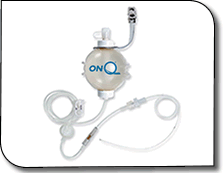
The On Q pain pump is a wonderful thing:
I was given a local anesthetic via a small, high-tech balloon that automatically dispenses anesthetic slowly and continuously to my foot. A catheter was inserted into the back of my leg just above the knee and the balloon was placed into a small pouch I wore around my neck. My anesthesiologist pre-set the pump so the anesthetic would continue to dispense for three days. It was wonderful. I didn’t feel any pain after my surgery and didn’t need to take pain meds once I’d gone home. I was able to get around easily on my crutches and didn’t feel sick. I spent a blissful two days reading, sleeping and texting friends and family about how good I felt.

The On Q pain pump running out a day too early is a horrible thing:
I woke up Wednesday night to a terrible stinging pain in my foot. I began taking pain meds, which at first didn’t work then made me sick. When my anesthesiologist called to check up on me the next day he told me the pump must have dispensed too quickly. The block was supposed to last a day longer. The good news was the terrible stinging pain wasn’t coming back, so I wouldn’t need any more pain meds. My husband was easily able to remove the catheter and dispose of it in our trash.

Crutches are not as easy as they look:
I am so glad I practiced using crutches beforehand. Actually, in my pre-surgery appointment I was told if I didn’t know how to use the crutches I would be sent to crutch training before I could leave the out-patient facility. This would be charged to my insurance company at an enormous out-patient rate. I watched a couple of eHow videos on maneuvering stairs and thought I was good to go. After using crutches for five days, I have to say I can’t imagine using them if I wasn’t in decent physical condition. My balance and core strength have helped immensely, but I still managed to strain my shoulder and blister my hand. Tote bags are a necessity for transporting objects from one room to another.

Listen to your doctor:
Lastly, I want to say listen to your doctor and not the naysayers. I can’t tell you how many co-workers/gym acquaintances told me how awful this surgery and the recovery process was going to be. Today, I read on-line that there are 100 different types of bunion surgeries available, most likely resulting in 100 different type of recoveries. So far my recovery hasn’t been so bad, other than Wednesday. The week I was home with bronchitis was much worse.

Since I am so well rested I actually feel better than I normally do and am looking forward to spending the coming week working from home. Who knows it could end up being one of my most productive weeks of the year.

Thursday, August 15, 2013

My Blog Makeover

Charming Blog Design As some of you have already noticed my site has a new design. The updated look was designed and created by Iris of Charming Blog Design. I couldn’t be happier with the results. Iris was so easy to work with. She asked for examples of what I liked before giving me several samples to choose from - which worked well for a non visual person like me. 

Iris is from Heidelberg, Germany. In addition to designing blogs, she is a student majoring in Elementary Education, enjoys crafting, collecting and creating birdhouses, nature photography, music, and blogging about her long distance relationship. If you are looking for a new blog design, I highly recommend her.

Go HERE to get in touch with Iris and give your own blog a new look! :-)

Sunday, August 11, 2013

Bout of Books Read-A-Thon

Bout of Books
Finally a read-a-thon I can participate in.  Due to my work/cleaning/always one step behind schedule I've never managed to find the time to participate in a read-a-thon until now:

The Bout of Books read-a-thon is organized by Amanda @ On a Book Bender and Kelly @ Reading the Paranormal. It is a week long read-a-thon that begins 12:01am Monday, August 19th and runs through Sunday, August 25th in whatever time zone you are in. Bout of Books is low-pressure, and the only reading competition is between you and your usual number of books read in a week. There are challenges, giveaways, and a grand prize, but all of these are completely optional. For all Bout of Books 8.0 information and updates, be sure to visit the Bout of Books blog. - From the Bout of Books team

I am delighted to see Bout of Books is holding their read-a-thon the week I am having foot surgery.   My bunionectomy is August 20th, so once I've settled into recovery mode I will look forward to reading my way through my TBR list and socializing with other book bloggers. I have quite a week of book reading planned I hope I am up to the task.

Sunday, August 04, 2013

I’ve Been Washing My Face with Plastic

In today’s Milwaukee Journal Sentinel article Cleanser beads could affect fish I discovered the exfoliating beads in exfoliating washes, soaps and toothpaste I use include small beads of plastic.

According to the article, in a recent study thousands of these small plastic pieces were discovered in water samples taken from Lake Superior, Lake Huron and Lake Erie. It turns out a single tube of Clean and Clear scrub from Johnson and Johnson contains 330,000 beads. The problem is these plastic beads float and water treatment plants aren’t designed to deal with floating matter. Researchers are worried that fish might think the pellets are eggs and eat them. That's problematic because plastics tend to absorb pollutants, such as PCBs, pesticides and motor oil. So the beads could poison the small fish that larger fish prey on. The larger fish are eaten by humans, which poses a human health risk.

The good news is faced with the results, the major manufacturers, including L'Oreal, the Body Shop and Johnson and Johnson, have committed to phasing out the plastic microbeads by 2015. Proctor and Gamble said it would follow by 2017, according to a story by CBC News in Canada.

I recently was considering removing foods that contain additives from my diet. This challenge was going to focus only on food and food additives, but now that I know there is plastic in my soap I’m also going to pay more attention to what is in my beauty products.

Have you ever been surprised to learn a harmful or unusual additive was included in a product you use? Did this knowledge change your purchasing habits?

Would you like to see additional consumer education posts similar to this one or would you prefer posts about books and/or career related topics?

Sunday, July 28, 2013

Should My Dog’s Teeth Be Professionally Cleaned?

Ten years ago while we were about to become a dog owner for the first time a friend was contemplating whether she should have her 11-year old dog’s teeth professionally cleaned. The procedure would cost $250. Professionally cleaning a dog’s teeth! I had never heard of such a thing. My friend not wanting to subject her older dog to the anesthesia decided to forego the procedure.

I faced a similar decision a couple of weeks ago when my husband returned from taking Teddy our eight-year old yellow Labrador retriever to the vet.


Our vet who had been keeping an eye on Teddy’s teeth for some time now recommended we have his teeth professionally cleaned. Teddy had developed a mild form of gingivitis. His teeth which had begun showing signs of plaque when he was only two year old were now brown and his gums were red and swollen. We received a quote of $412 without x-rays, $599 with for this procedure. The x-rays were needed to determine if any teeth needed to be extracted. The cost of teeth extraction was extra. $600!!! The cost of teeth cleaning had gone up quite a bit in ten years.  

We looked at Teddy’s teeth ourselves:


and decided to go ahead with the procedure. Our vet thought Teddy may be in pain – we had noticed there were times when Teddy ate slower and more tentatively than usual. In addition, not having them cleaned now could lead to other health problems later on. The bacteria from gingivitis could travel through Teddy’s bloodstream contributing to heart, kidney or liver disease. His teeth would also continue to deteriorate which could lead to infection, teeth loss and difficulty eating.

His x-ray’s detected one bad tooth that had to be extracted. The upper right 12 incisor was fractured and its pulp was exposed. Not removing it could lead to an abysses tooth and damage to the teeth surrounding it.


The cost of the procedure included pre-anesthetic blood work. These tests checked Teddy’s blood sugar, kidney values, and red blood cell count. They were to detect abnormalities that could affect anesthesia. He also received intravenous fluids during anesthesia. These were given to combat a decrease in blood pressure which sometimes results from the anesthesia drugs. In addition, an intravenous catheter allows immediate administration of emergency drugs if there is an adverse reaction from the anesthesia.    

Here is the break down of costs for Teddy’s professional teeth cleaning including tooth extraction:
........ ........ ........
DescriptionCost
Anesthesia and IV Catheter43.70
Pain Injection (2)48.40
Surgical Monitor30.20
Scale and Polish Teeth81.70
Fluoride Treatment23.00
Day-Care Kennel Use20.60
Cefazolin (Antibiotic)21.00
IV Fluids During Surgery21.60
Radio graph Dental Full Mouth130.00
CHEM/CBC/UA In-House0.00
Chem Panel w/Electrolytes72.82
CBC (Complete Blood Count)49.30
Nerve Block(s)18.50
Rimadyl 100mg Chewable (4)18.20
Non-Surgical Tooth Extraction35.00
Total$614.20
Teddy did very well at the clinic and other than a couple of hours of whimpering at home (which resulted in lots of pets and belly rubs) he had a speedy recovery. Here is a photo of his clean pearly whites.


We are to begin Brushing Teddy’s teeth in 2 weeks. For best results, we should brush them 3-4 times a week.

Buck our ten-year old golden retriever has never had his teeth professionally cleaned. He hasn’t needed it. We’ve always brushed both our dog’s teeth once a week. Buck does chew on sticks more often and has a morning routine that includes chewing on his Galileo bone which may have helped prevent tartar buildup.

In hindsight, I should have paid more attention when my friend was contemplating whether or not to have her dog’s teeth cleaned. Dogs are expensive, much more expensive than I ever could have imagined before owning one. Though I do think our vet is on the high side and some of the above services may not have been necessary, i.e. a charge for day-care kennel use I do want my dogs to be healthy and receive good veterinary care.

Have you ever had your dog’s teeth professionally cleaned? Are there any home remedies you practice to keep your dog’s teeth clean? What about the cost of Teddy’s professional cleaning? Was $600 for this procedure low, about average or kind of high?

Sunday, July 21, 2013

Explaining why I was fired – and when to tell a potential employer I’m pregnant?


Dear Savvy,
I recently was let go from my job as a financial representative’s assistant. This was my first job out of college and not related to my major. I wasn’t told until after I was hired I needed to obtain both an insurance and series 6 license as a requirement of continued employment. I took the insurance classes, but was having difficulty passing the life exam. I then took several days off due to a family event and a vacation. When I returned my manager called me into his office to inform me I wasn’t working out. He needed an assistant who was certified. Since losing this job, I’ve had one phone interview for a position in my field of study. When asked why I was no longer working, I told the interviewer I had difficulty passing the insurance exam. I was nervous and rambled a bit giving the dates of my exams and the scores I received. I was not called back for a second interview. My parents think I shouldn’t have given so much detail about the exams and instead say I was not told during the interview process I needed to become a certified insurance agent nor given a drop dead date for accomplishing this. How do you think I should respond to the question, “Why did you leave your last job?”  

Also, I am pregnant. I am not showing yet do I need to tell potential employers I am pregnant? If so when?
Lindsay

Dear Lindsay,
I disagree with your parent’s advice. Do not tell interviewers you weren’t informed of the insurance license requirement during the interview process. Interviewers may think you are naïve, didn’t do your homework, weren’t listening or are lying. I did a quick search on a local company’s website and found the following listed as a requirement for a similar job:

- Series 6 or 7, 66 or 65 & 63, and Life Insurance license required

Also, do not go into detail about taking the exam. Instead say, “I was required to become licensed by such and such date and when I failed to do so I was let go. I now realize this job wasn’t for me. I went to school for X and this position did not utilize my talents which are ….” The closer your talents match the job you are applying for the better.

As to alerting potential employers you are pregnant, do not do so until you have a firm job offer.  I am reminded of the seminar I attended on hiring discrimination. The speaker, an HR hiring manager at a large company, told us hiring discrimination absolutely exists for women in their child-bearing years. When a manager at her company knows an interviewee is pregnant she is rarely (as in never) considered for hiring or promotion. Why - because someone, either the manager or other employees, have been covering this position since it became open. If they hire a pregnant person they know in a few months someone will once again need to cover this position while the employee is out on maternity leave. There is also the fear the employee will forget everything she learned and need to be retrained once she returns or at the very least will need to be brought up to speed on what occurred while she was out. Then there is the fear she may decide to stay home with her new baby and they will need to start the hiring process all over again.

Once hired you do need to inform your new employer you are pregnant as soon as possible, they will need to plan for it. After you receive a firm job offer in writing let them know you will be accepting the offer, but do need to inform them you are pregnant and the baby is due on…They will not be happy, but most likely will not rescind your job offer in fear of a discrimination law suit.
 
Have you ever been fired? How did you explain your firing in an interview?

Were you ever pregnant while searching for a job? At what point did you alert the interviewer you were pregnant? Were you still hired?

If you enjoyed this post you may also like:
I've lost my job. Now what?
50 Best Books for the Unemployed
Worker Embarrassed to Attend Retirement Party After Being Fired

Tuesday, July 16, 2013

Wild: From Lost to Found on the Pacific Crest Trail

Motivation for Reading:
Cheryl Strayed’s book Wild: From Lost to Found on the Pacific Crest Trail has been on my reading list since Oprah selected it for her revamped book club.

At 26 Cheryl Strayed was by her own admission a mess. She had lost her mother to cancer, was divorced from her young husband, dating a junkie and on her way to becoming an addict herself. Feeling lost she quits her waitressing job and sets out to hike the Pacific Crest Trail. The purpose for her journey according to Cheryl:
I had to change. I had to change was the thought that drove me in those months of planning. Not into a different person, but back to the person I used to be – strong and responsible, clear-eyed and driven, ethical and good. And the PCT would make me that way. There, I’d walk and think about my entire life. I’d find my strength again, far from everything that had made my life ridiculous. (pg. 57)
What better book to read for my Be Strong reading project - a reading challenge I created for myself to read one book about strength each month.

My thoughts:
I am glad I read Cheryl Strayed’s book Tiny Beautiful Things: Advice on Love and Life from Dear Sugar, a book I had loved, prior to reading this one. If I hadn’t already been familiar with Cheryl’s work I doubt I'd have finished this book. I found Cheryl’s lack of adequate preparation for her hike (no backpacking experience to speak of, too heavy of a pack, one-size too small shoes, not enough money, etc.) irresponsible and dangerous. Also, I kept comparing this book to Bill Bryson’s book A Walk in the Woods: Rediscovering America on the Appalachian Trail about hiking the Appalachian Trail which I found funnier and thought he did a better job of actually writing about the trail. Once I stopped judging Cheryl and accepted this book for what it was – Cheryl’s journey - I began enjoying it. I realized Cheryl’s writing is just as beautiful as it was in Tiny Beautiful Things: Advice on Love and Life from Dear Sugar and I had to give her credit; she was no quitter.  She achieves both her goals to hike the Pacific Crest Trail and to find her strength.

Here are a couple of my favorite quotes from the book:
The father's job is to teach his children how to be warriors, to give them the confidence to get on the horse to ride into battle when it's necessary to do so. If you don't get that from your father, you have to teach yourself.
 And:
What if I forgave myself? I thought. What if I forgave myself even though I'd done something I shouldn't have? What if I was a liar and a cheat and there was no excuse for what I'd done other than because it was what I wanted and needed to do?...What if I was never redeemed? What if I already was?
Also, there is an excellent scene in the book where Cheryl uses the intuition skills Gavin de Becker writes about in his book The Gift of Fear and Other Survival Signals that Protect Us From Violence.  When approached by a suspicious pair of hunters on the trail and though tired and hungry Cheryl runs ‘til she can’t run anymore out of fear one of them will come back to find her.

Bottom Line:
If you are looking for a well-written memoir about a lost soul who embarks on a journey to find herself along the PCT this is a good book for you. If you are looking for a book about the trail itself, a professional guide to backpacking or a book about getting back to nature you probably will not enjoy this book. 

Have you read this book?  If so, what were your thoughts?

If you enjoyed this book you may also like:
Tiny Beautiful Things: Advice on Life and Love From Dear Sugar
How Did You Get Into Nonfiction?
Nonfiction You Can't Put Down

Please Note I am an Amazon affiliate.

Tuesday, July 09, 2013

Tiny Beautiful Things: Advice on Love and Life from Dear Sugar

Motivation for reading:
I decided to read Cheryl Strayed’s book Tiny Beautiful Things: Advice on Love and Life from Dear Sugar after Rebecca Joines Schinsky included it on a list of books to read through your quarter life crisis over on Book Riot.

Rebecca wrote:
Strayed pushes us to know that we make ourselves, and it’s up to us to make ourselves whole. Someone in these pages will have the problem you have had or are having. Many someones will have it much worse. You will get perspective and reassurance and at least one that’s-exactly-what-I-needed-to-hear moment.
At 50, I’m not going through a quarter-life crisis, but a mid-life one and could certainly use a little perspective as I continue to make my way, so I decided to give the book a try.

What is Tiny Beautiful Things: Advice on Love and Life from Dear Sugar about?
Cheryl Strayed, the author of Dear Sugar an online advice column at The Rumpus, has put together a book of her best Dear Sugar columns along with a few that have never before been published.

My Thoughts:
Before reading this book, I was concerned an entire book of columns might be advice overload, so when I packed it for a recent vacation it was almost as an afterthought; perhaps I’d read a column or two. Once I began reading, I was so taken with Cheryl’s writing and her advice I couldn’t put the book down. I will warn you though Cheryl includes a story from her own life in every column instead of just giving advice. While I enjoyed this, some of you may not. 

Here is some of the advice I am taking to heart:
To the husband whose wife lost her mother:
Say Oh honey, I’m so sorry for your loss over and over again. (Page 98)
I’ve been in several situations where someone I know has lost a loved one and I’m never sure what I should say or do. Cheryl suggests being there and saying you are sorry over and over is what you need to do. It doesn’t make it okay, but it makes it better.

The guidance Cheryl gives the wife whose husband had an affair with a young woman the wife hired for the family business is perfect. Instead of forgiving the young woman Cheryl suggests she first accept the situation.
“Acceptance asks only that you embrace what is true.” (Pg. 113)
She recommends the wife neutralize her negative thoughts with a breath. Calm your mind. Breathe in deeply with intention, and then breathe out. Cheryl has breathed her way through many people she feels wronged by.

Then there is the Dear Sugar column I wrote about in my post Is It Possible to Change the Course of a Young Girl's Life. In this column, Cheryl writes about her experiences working as a youth advocate. Initially she tries to help the teens by getting the authorities to intervene. When no one comes to their aid and she’s told there is no money for kids over the age of 12, Cheryl changes her advice. She tells the girls to survive it. To endure it. This column gives me goose bumps every time I read it.

And lastly, the mental vision I have of the ‘rain” song Cheryl sings with the children in 'Ten Angry Boys' has stayed with me long after reading the book.

Bottom Line:
Tiny Beautiful Things: Advice on Love and Life from Dear Sugar isn’t what I would call a light vacation read. I had been feeling a bit down prior to my vacation and this book didn’t exactly bring me up. I spent a couple of days wallowing in my dysfunctional childhood, but the book did help me see things from a different point of view. I came away able to forgive someone from long ago and also to feel reassured I did the right thing in distancing someone else. All in all reading the book was good for me and I gained perspective. I can only imagine how much I'd have gotten out of it if I had read it during my quarter-life crisis.

Have your read this book?  If so what were your thoughts?

If you enjoyed this post you may also like:
New Perspectives
Life is Not About Perfection
Career Book Recommendations and Advice From FrauTech
How Not to Lose Your Cool When Your Manager Screams at You

Please Note I am an Amazon Affiliate.

Friday, July 05, 2013

Guest Post: 6 Books to Help You Find Inner Strength

Today you can find me over at Sophisticated Dorkiness where I am sharing a guest post on Kim Ukura’s blog. Kim is a bookworm and book blogger who has had a huge influence on this blog and my reading life. In case you don't believe me, check out this list of blog posts in which I’ve mentioned Kim:

Getting a Clue About Feminism

50 Books Every Young Woman Should Read

Anne Lamott's 'Bird by Bird: Some Instructions on Writing and Life' and Jealousy

Searching for the Truth

Memorable Vacation Reads

Making Women Count: Ending the Year on a Low Note

Light Reading

Deciding to Join the Bleak House Read-Along

I also want to highlight Kim’s latest endeavor - a nonfiction recommendation feature where she is offering personal nonfiction recommendations. To receive yours, just fill out the questions on this form and, over the next month or so, she will go down the list and recommend books. Since I am a huge fan of nonfiction, I'm looking forward to Kim’s picks which I'm sure will guarantee my TBR list will never be without books.

My guest post summarizes six of the books I’ve read date to-date that have had the biggest impact on my strength challenge - a challenge I created last summer when after having difficulty once again thinking on my feet I decided to challenge myself to become a stronger person in my 50th year. Initially I had visions of taking yoga classes and pursuing other physical challenges, but after an injury my challenge quickly morphed into a reading challenge. I decided to read at least one book a month that dealt with an aspect of inner strength such as confidence, communication skills, dealing with difficult people or circumstances, self-knowledge, willpower, etc. To read the post in its entirety click here: 6 Books to Help You Find Your Inner Strength.