Showing posts with label Life Lessons. Show all posts

Sunday, January 18, 2015

Reading to Understand Life’s Transitions Featured on Be Our Guest Fridays


This week I was delighted to be the guest blogger on Tanya at Mom's Small Victories and Helen at My Novel Opinion's sites for their #BeOurGuestFridays feature. In my post I share how I read to understand life's transitions. Head on over to learn the books that have helped me the most.  Don't forget to let me know what books have helped you understand life's transitions.

Wednesday, April 30, 2014

Lean Back and Thrive

In Arianna Huffington’s book Thrive she describes a new definition of success, one that focuses not only on career advancement, but on the equally important goals of health and wellbeing, personal fulfillment, giving back and living a life of purpose and meaning.

She writes:
Our current notion of success, one in which we drive ourselves into the ground, if not the grave – in which working to the point of exhaustion and burnout is considered a badge of honor – was put in place by men, in a workplace culture dominated by men.
And:
Women are paying an even higher price than men for their participation in a work culture fueled by stress, sleep deprivation, and burnout. 
Instead of focusing on the two traditional metrics of success, she recommends adding a third metric. This third metric includes our well-being, our ability to draw on our intuition and inner wisdom, our sense of wonder and our capacity for compassion and giving.

I find it interesting how as I've gotten older my goals and aspirations are leaning more towards the third metric.  My twenties were all about making money and working as many hours as possible.  In my thirties I returned to college, passed the CPA exam, found a new job and again worked long hours.  In my forties, I began burning out and dreamed of vacations and early retirement.  I started exercising and taking better care of myself to help combat chronic insomnia. Now that I'm over fifty I dream of mentoring and giving back. Instead of leaning-in to my career I long to lean back and have a more well-rounded life.

Finding the time to add this third metric - meditation, yoga, getting enough sleep, renewing ourselves and giving back - to my life can be challenging especially while working full-time and attempting to maintain this blog. (By the way I consider this blog part of my third metric). For me, the only way I can make this all work is to schedule everything. Cleaning my house, cooking, shopping, blogging, exercising, work meetings and deadlines, spending time with my family and friends – everything is scheduled. I am also someone who doesn’t work well under tight deadlines, so anything that upsets my schedule also upsets this third metric.  

Another thing I’ve noticed as I’ve become more involved with social media I’ve been staying up later and sleeping less.  I’ve even been known to bring my electronic devices to the dinner table much to my husband’s displeasure. The problem with social media is I’m never finished. I could always write one more comment or schedule one more tweet.  It’s time I take a step back.  I need to cut-back on my social media participation.  My social media activity is now scheduled from 8:00 pm to 9:30 pm allowing me a half hour downtime before falling asleep.

This past week I read three blog posts from three different women about how their career goals have changed as they got older.  All three wanted to lean back rather than lean into their career.  One wanted to spend more time with her family, one wanted a different career from the one she's been working towards since she was sixteen, and the third wanted to spend more time giving back.

Have your career goals changed over time?  Do you dream of leaning-back?


This post was inspired by Thrive: The Third Metric to Redefining Success and Creating a Life of Well-Being, Wisdom, and Wonder by Arianna Huffington who encourages everyone to sleep their way to the top. Join From Left to Write on May 1 we discuss Thrive. As a member, I received a copy of the book for review purposes.


Sunday, March 16, 2014

48 Days To The Work You Love

What is Dan Miller's book 48 Days To The Work You Loveabout?
Dan Miller, a life coach, has written a book not about finding a new job, but about discovering what you are going to “be.” According to Miller, failing to make that fundamental discovery is why so many people find themselves in jobs they hate. His book is to help lead you to the vocation you will love.

Motivation for reading:
This book has been included on several must-read career book lists, but it wasn’t until Sarah Ingle mentioned it in her post things I wish I'd been told in college that I decided to read this book. She wrote:
I wish someone had made me read 48 Days To The Work You Love.  I know I talk about this book all the time, but it was the first thing I ever read that actually helped point me in a direction. I think every college freshman or sophomore should be REQUIRED to read something like this before they waste thousands of dollars on classes that are useless and have no direction. 
If you are a regular reader of this blog, you may have noticed I’ve been feeling trapped in my career as an accounting manager for some time now. I’ve worked in accounting for 25 years and would like to do something more fulfilling in the next stage of my life. I was hoping this book would provide some insight.

My thoughts:
This book is not a step-by-step how-to-guide to finding a new career in 48 days; instead it is a book filled with anecdotes and stories from Miller’s coaching practice, the bible and quotations from other books. Each chapter does end with a list of questions designed to get you thinking about your own life and its purpose. Overall, I thought the book was a bit repetitive. I would have preferred a more logically organized step-by-step book, but reading it was not an entire waste I came away with several invaluable insights. Here is a sampling:

Not only know yourself, but know what is changeless about you:
The power of knowing yourself acts as a compass through change. Popular writer Steven Covey says the only way we can handle change is to know what is changeless about ourselves. You need that changeless core, knowing how God has uniquely gifted you and what you value. With that knowledge you can forge through change with clear direction and unshakeable purpose. (Pg. 31)

On having action plans and setting goals:
A plan of action will separate you from 97% of the people you meet. Everyone has dreams, but very few ever turn those into goals. The difference between a dream and a goal is that a goal is a dream with a timeframe of action attached. (Pg. 48)

Only 8% of the general population can identify goals and only about 3% ever actually write them down. (Pg. 56)

Goals are not written in concrete terms but certainly give you a starting point and a destination. The important thing is you are working on your goals; your life has meaning only when you are working towards goals through with your achieve meaning. After all, success is the progressive realization of worthwhile goals. (Pg. 57)

Indecision is the greatest thief of opportunity:
A recent Harvard Business School Study asked, “What are the top characteristics of high achievers?” At the very top of the list, one characteristic stood out: speed of implementation – having the ability to act quickly. Eighty percent of decisions should be made immediately. (Pg. 55)

When confronted with a decision Dan and his wife allow a 2-week maximum for arriving at a decision. Here is their approach to the process:

1. State the problem
2. Get the advice and opinions of others
3. List alternatives
4. Choose the best alternative
5. Act

Look for what you love first:
Looking for the best opportunities in career and jobs often leads to disillusionment and frustration. Look for what you love first. Then you will have the confidence and enthusiasm to find success in places others overlook. (Pg. 188)

I enjoyed the chapter on entrepreneurship. It contained one of the best “Do you have what it takes to be an entrepreneur questionnaire” I’ve seen. It is extensive – at 18 questions and does not include your typical are you a risk taker type question.

The chapter on interviewing pointed out how important it is to appear energetic and enthusiastic during the interview process.

Bottom line:
I may not have determined what my next career will be, but I did gain valuable insights from reading this book. I recommend it to anyone just starting out or searching for a new vocation with this caveat - Miller writes this book from a Christian point of view. If this will bother you, you may want to skip this book.

What is the best career book you’ve ever read?

Please Note, I am an Amazon Affiliate

Friday, November 01, 2013

The Savvy Reader Book Club Choices for November

The Savvy Reader Book Club is an online nonfiction book club created for the serious reader.  At the beginning of each month I select one or two books then host discussion posts covering the books throughout the month.  If you write a blog post about one of my selections I will be happy to include its link in my final post.

I actually cannot believe it is November 1st already and yes I do realize I am a bit behind on previous book club posts.  I am going to really try to catch-up this month.

Here are my book club selections for November:

Fellow blogger Crystal Ponti's book The Mother of All Meltdowns: Real Stories of Moms' Finest (Worst, Completely Awful) Moments. Crystal has written, along with twenty-nine fellow (mom) bloggers, a book that features tales from the trenches of motherhood. This anthology takes an honest look at the moments that bring even the strongest mama to her knees. Bonus content reveals the secrets to surviving the most harrowing meltdown with grace, composure, and maybe a little wine.

I've already begun reading this book and guarantee if you decide to read this one along with me you will not be disappointed:


For my second selection I am going with Seth Godin's book Tribes: We Need You to Lead Us:


Have you read either of these books? If so what were your thoughts? Be sure to stop back  throughout the month to participate in my book discussions.

Please Note, I am an Amazon Affiliate

Sunday, August 25, 2013

My Bunionectomy

Photo Credit: A.Currell via Compfight cc
A bunion (hallux valgus) is a bulging bump on the side edge of the joint at the base of the big toe. Over time this bump can become enlarged and inflamed and may cause your first toe to begin pointing towards your smaller toes. Foot pain from a bunion can be so severe that it interferes with normal activities like walking. Most people who acquire bunions have a hereditary predisposition to developing them. Also, wearing high-heeled shoes with a narrow toe box does not help.

In my case, both my mom and dad have bunions as well as both of my sisters and at least one aunt. I did spend twenty years wearing high-heeled usually pointy shoes. My doctor described my bunion as moderate to severe and recommended surgery. There is nothing that can be done to reverse a bunion once it has formed other than surgically removing it and straightening the bones of the toe. This is done so the bunion does not return. The bunion on my right foot was much worse than the one on my left. It was always red and swollen at the end of the day no matter what shoes I wore or how much physical activity I engaged in. I haven’t worn high-heeled shoes in two years and have modified my exercise routine to not include anything that irritated my bunion like lunges.

I had a bunionectomy on my right foot on Tuesday. I chose this day because this is the slowest time of the year for me at work. After surgery I am not allowed to walk on my foot for at least 10 days and my doctor doesn't recommend driving. After practicing walking down lannon stone stairs to my unattached garage while on crutches I realized he was right. I would never be able to do this at least not by myself, so I’ve been home. Never in my adult life have I been house bound for ten straight days before.

Here are a few lessons I’ve learned from my surgery:
Why they recommend having someone go with you to your doctor’s appointments:
Despite having mentally prepared for this surgery and thinking I was not nervous the day of, after the first nurse left my pre-surgery room I realized I had not heard a word she had said. I had to ask my husband, “What are these?” “Socks” "What am I supposed to do first?" Clearly I was more nervous than I had thought. I realized how easy it would be in those important doctor appointments to miss vital information.

They will make you pee in a cup despite insisting you are not pregnant:
Seriously! I haven’t had anything to drink in ten hours and besides I’m 51.

Blogging plays a larger role in my life than I had thought:
I’ve never had surgery while under a general anesthetic before and was curious what my first words  in recovery would be. I must say I was a little surprised that they were, “How am I supposed to blog about this? I don’t remember a thing.” At the time I was genuinely annoyed. I had been looking forward to at least seeing the surgery unit and my doctor. I wanted to hear him say, “Yes good thing we are doing this, your bunion is pretty swollen today.” The last thing I remember was being wheeled out of my room. I then asked if I could keep the X-ray I’d been handed of my foot with it’s eight new pins. I was sure I could figure a way to post it onto my blog. The nurse took it from me saying, “We will keep it for you right here in your folder.” Once I got back to my room I realized that folder wasn’t coming home with me. Again I was annoyed, but decided to let it go.


The On Q pain pump is a wonderful thing:
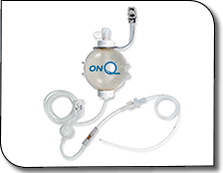
I was given a local anesthetic via a small, high-tech balloon that automatically dispenses anesthetic slowly and continuously to my foot. A catheter was inserted into the back of my leg just above the knee and the balloon was placed into a small pouch I wore around my neck. My anesthesiologist pre-set the pump so the anesthetic would continue to dispense for three days. It was wonderful. I didn’t feel any pain after my surgery and didn’t need to take pain meds once I’d gone home. I was able to get around easily on my crutches and didn’t feel sick. I spent a blissful two days reading, sleeping and texting friends and family about how good I felt.

The On Q pain pump running out a day too early is a horrible thing:
I woke up Wednesday night to a terrible stinging pain in my foot. I began taking pain meds, which at first didn’t work then made me sick. When my anesthesiologist called to check up on me the next day he told me the pump must have dispensed too quickly. The block was supposed to last a day longer. The good news was the terrible stinging pain wasn’t coming back, so I wouldn’t need any more pain meds. My husband was easily able to remove the catheter and dispose of it in our trash.

Crutches are not as easy as they look:
I am so glad I practiced using crutches beforehand. Actually, in my pre-surgery appointment I was told if I didn’t know how to use the crutches I would be sent to crutch training before I could leave the out-patient facility. This would be charged to my insurance company at an enormous out-patient rate. I watched a couple of eHow videos on maneuvering stairs and thought I was good to go. After using crutches for five days, I have to say I can’t imagine using them if I wasn’t in decent physical condition. My balance and core strength have helped immensely, but I still managed to strain my shoulder and blister my hand. Tote bags are a necessity for transporting objects from one room to another.

Listen to your doctor:
Lastly, I want to say listen to your doctor and not the naysayers. I can’t tell you how many co-workers/gym acquaintances told me how awful this surgery and the recovery process was going to be. Today, I read on-line that there are 100 different types of bunion surgeries available, most likely resulting in 100 different type of recoveries. So far my recovery hasn’t been so bad, other than Wednesday. The week I was home with bronchitis was much worse.

Since I am so well rested I actually feel better than I normally do and am looking forward to spending the coming week working from home. Who knows it could end up being one of my most productive weeks of the year.

Tuesday, July 09, 2013

Tiny Beautiful Things: Advice on Love and Life from Dear Sugar

Motivation for reading:
I decided to read Cheryl Strayed’s book Tiny Beautiful Things: Advice on Love and Life from Dear Sugar after Rebecca Joines Schinsky included it on a list of books to read through your quarter life crisis over on Book Riot.

Rebecca wrote:
Strayed pushes us to know that we make ourselves, and it’s up to us to make ourselves whole. Someone in these pages will have the problem you have had or are having. Many someones will have it much worse. You will get perspective and reassurance and at least one that’s-exactly-what-I-needed-to-hear moment.
At 50, I’m not going through a quarter-life crisis, but a mid-life one and could certainly use a little perspective as I continue to make my way, so I decided to give the book a try.

What is Tiny Beautiful Things: Advice on Love and Life from Dear Sugar about?
Cheryl Strayed, the author of Dear Sugar an online advice column at The Rumpus, has put together a book of her best Dear Sugar columns along with a few that have never before been published.

My Thoughts:
Before reading this book, I was concerned an entire book of columns might be advice overload, so when I packed it for a recent vacation it was almost as an afterthought; perhaps I’d read a column or two. Once I began reading, I was so taken with Cheryl’s writing and her advice I couldn’t put the book down. I will warn you though Cheryl includes a story from her own life in every column instead of just giving advice. While I enjoyed this, some of you may not. 

Here is some of the advice I am taking to heart:
To the husband whose wife lost her mother:
Say Oh honey, I’m so sorry for your loss over and over again. (Page 98)
I’ve been in several situations where someone I know has lost a loved one and I’m never sure what I should say or do. Cheryl suggests being there and saying you are sorry over and over is what you need to do. It doesn’t make it okay, but it makes it better.

The guidance Cheryl gives the wife whose husband had an affair with a young woman the wife hired for the family business is perfect. Instead of forgiving the young woman Cheryl suggests she first accept the situation.
“Acceptance asks only that you embrace what is true.” (Pg. 113)
She recommends the wife neutralize her negative thoughts with a breath. Calm your mind. Breathe in deeply with intention, and then breathe out. Cheryl has breathed her way through many people she feels wronged by.

Then there is the Dear Sugar column I wrote about in my post Is It Possible to Change the Course of a Young Girl's Life. In this column, Cheryl writes about her experiences working as a youth advocate. Initially she tries to help the teens by getting the authorities to intervene. When no one comes to their aid and she’s told there is no money for kids over the age of 12, Cheryl changes her advice. She tells the girls to survive it. To endure it. This column gives me goose bumps every time I read it.

And lastly, the mental vision I have of the ‘rain” song Cheryl sings with the children in 'Ten Angry Boys' has stayed with me long after reading the book.

Bottom Line:
Tiny Beautiful Things: Advice on Love and Life from Dear Sugar isn’t what I would call a light vacation read. I had been feeling a bit down prior to my vacation and this book didn’t exactly bring me up. I spent a couple of days wallowing in my dysfunctional childhood, but the book did help me see things from a different point of view. I came away able to forgive someone from long ago and also to feel reassured I did the right thing in distancing someone else. All in all reading the book was good for me and I gained perspective. I can only imagine how much I'd have gotten out of it if I had read it during my quarter-life crisis.

Have your read this book?  If so what were your thoughts?

If you enjoyed this post you may also like:
New Perspectives
Life is Not About Perfection
Career Book Recommendations and Advice From FrauTech
How Not to Lose Your Cool When Your Manager Screams at You

Please Note I am an Amazon Affiliate.

Tuesday, June 25, 2013

Strength Interview with Ran Zilca of 'Ride of Your Life'


Last summer, while researching inner-strength for my BE Strong Challenge –  a challenge I created for myself to become a stronger person in my 50th year - I discovered a fantastic article on Building Inner Strength by Ran Zilca on Psychology Today. This article remains the best article I’ve read to-date on inner-strength, so you can imagine how excited I was to learn Ran is writing a book about his journey towards inner peace. I recently had the opportunity to interview Ran for my strength challenge:

What is your book - A coast to Coast Journey to Inner Peace about? And when will it be released?
The book is a guide to inner peace, composed over a 6,000 mile, coast-to-coast solo motorcycle ride I took in 2010. I started in New York and rode to California and then down the California coast line. On my way I interviewed different scientists and authors like Deepak Chopra, Phil Zimbardo, Sonja Lyubomirsky, and Byron Katie. The collective wisdom of these experts and of the many people I met on the road, along with the meditative experience of riding in solitude each day, yielded very interesting insights that form the guide.

I am running a Kickstarter Campaign (see below). If it’s successful the book will come out for the new year.

What motivated you to undertake this journey?
I was just turning 40, and being very successful in business and in my personal life, but unsure as to who I really am. I think that many people experience this type of feeling in midlife, where they know what they do and where they live, but not exactly sure who they are. It made me feel restless, so I went out to rediscover my identity, quiet the restlessness, and regain my inner peace.

What makes you feel strong?
When you lift weights you put a strain on your muscles, and in turn that builds muscle mass. Mental strength is built in the exact same way – by facing and meeting challenges, and going outside your comfort zone. I got my motorcycle license only a year before going on the road, and it was very hard for me to learn how to ride, and become good at it. It was also very hard, in many different ways, to go on the road and leave home for 5 weeks. I missed my wife and my kids, and even though my wife was very supportive of the project, it was very hard on her as well. I also did not have much riding experience, and most days were filled with risks. For that very reason though, the pride of actually doing it made me feel much stronger in a very profound way.

What detracts from your strength or what do you see others doing that detract from their strength?
All of us have known energy-drains. It could be the interaction with certain people, being in certain situations, or worries and thoughts. To remain strong, it’s crucial to identify those, so you can keep the drain of strength to a minimum. 

What do you know now that you did not know when you were 18?
At 18 my identity was still forming, and today I know who I am and how to make decisions irrespective of what may be good for others. At the same time, I would never want to lose my perspective at 18, where anything was possible, and everything was starting to happen and materialize. The sense of strength in youth can be tremendous. 

Do you have any lessons that you’ve learned from your journey that may help me in my strength challenge?To do one thing each day that scares you and makes you feel uncomfortable, to live life in service of others, to give others credit before they act, and forgive them when they default on that credit. The biggest hurdle on the way to happiness and inner strength is one’s ego and a sense of self-importance.

Are there any books that have influenced you or that you find yourself always recommending to others?
Many :) Sonja Lyubomirsky’s The How of Happiness: A New Approach to Getting the Life You Want The How of Happiness, and Barbara Fredrickson’s Positivity: Top-Notch Research Reveals the 3 to 1 Ratio That Will Change Your Life (both authors that I was fortunate to interview) are great positive psychology guides for life. Deepak Chopra’s The Ultimate Happiness Prescription: 7 Keys to Joy and Enlightenment The Ultimate Happiness Prescription is also a great read that is very practical. When I was on the road I read John’s Steinbeck’s Travels with Charley, which is both a great travel story and a thought-provoker. But mostly – I find The Bhagavad Gita and the Tao Te Ching to be an executive summary of many texts on human happiness.

As I enter the second year of my challenge what should I focus on? I spent most of my first year gaining a better understanding of who I am.  
Here’s my advice: Make a list of things you want to do but feel uncomfortable doing, and start doing them! It could be small, daily things too. The pride you will feel will be a tremendous source of strength.

Tell me about your Kickstarter Project?
The Kickstarter Campaign allows everyone to pre-order the book, and also participate in its creation (!) by sending questions to the different experts. You can also get signed and dedicated copies, a coaching package, and other special rewards. The funding from the pre-orders will be then used to pay for the book’s production, but only if enough pre-orders are made.  

Is there anything else we should know about you?
Even though there’s some dose of adventure in my life, I live very normatively – house in the suburbs, take the kids to school and activities, etc. I love family life and the daily routine that comes with it.

Ran Zilca can be found at http://www.rideofyourlife.com/ and his Kickstarter Project can be found here.

Please Note, I am an Amazon Affiliate
Sunday, March 24, 2013

The Gift of Fear

As part of my "Be Strong" project, I’ve challenged myself to read at least one book a month dealing with an aspect of inner strength such as confidence, communication skills, working with difficult people, self-knowledge, willpower, etc. My February read was Gavin De Becker’s book The Gift of Fear and Other Survival Signals that Protect Us From Violence. I chose this book after Maria of Redirecting Chaos recommended reading it in the comments of previous posts not once, but twice

What is The Gift of Fear about?
Gavin de Becker, a security specialist based in Los Angeles and the founder of Gavin de Becker and Associates a private security firm whose clients includes Hollywood stars and government agencies, has written a book exploring how fear is a gift that can be used to keep us safe. The book explains how we can spot even subtle signs of danger—before it’s too late.

My Thoughts:
Gavin de Becker’s intention in writing the book was to share factors his company considers when identifying and predicting violent people and their behaviors in simple to understand terms. He achieves this by including powerful real life stories that left me chilled knowing these examples actually occurred.

I am highlighting some of the major lessons I learned from this book:

He provides potential warning signs to watch for when confronted by a stranger or manipulative person. He calls these survival signals:

  • Forced Teaming. Shown through the use of the word “we” a person tries to pretend he has something in common with you and that you are both in the same predicament when it isn’t really true.
  • Charm and Niceness. This is being polite and friendly to a person in order to manipulate them. Niceness does not equal goodness.
  • Too many details. When people lie, even if what they say sounds credible, it doesn’t sound credible to them, so they keep talking.
  • Typecasting. Always involves a slight insult and usually one that is easy to refute. For example: “You are probably too snobbish to talk to the likes of me.”
  • Loan Sharking. Offers assistance, but is always calculating the debt. The fact that you owe a person something makes it harder to ask them to leave you alone.
  • The Unsolicited Promise. This is one of the most reliable signals. It shows nothing more than the speaker’s desire to convince you of something. Ask yourself why does this person need to convince me? For example” “I’ll just put this stuff down and go. I promise.”
  • Discounting the Word “No”. Refusing to accept the word no.

“No” is a word that must never be negotiated and was the most important lesson I took from this book. The person who chooses not to hear the word “no” is trying to control you. Don’t trust them. If you let someone talk you out of the word “no” you might as well wear a sign that reads, “You are in charge.” (Pg. 62)

A woman alone who needs assistance is actually far better off choosing someone and asking for help, as opposed to waiting for an unsolicited approach. The person you choose is nowhere near as likely to bring you hazard as the person who chooses you. (Pg. 63)

Never show fear:
Threats are never spoken from a position of power. Whatever power they have is derived from the fear instilled in the victim, for fear is the currency of the threatener. (Pg. 109)

Persistence only proves persistence:
It does not prove love. The fact that a romantic pursuer is relentless doesn’t mean you are special – it means he is troubled. (Pg. 196)

Women should never explain why they don’t want a relationship:
Mr. Wrong will challenge each reason she offers. Instead women should make it clear they have thought it over, that this is the decision and that they expect the man to respect it. (Pg. 199)

The problem with restraining orders:
Many batterers find intolerable the idea of being under the control of their victims, and with a court order, a woman seeks to control her husband’s conduct, thus turning the tables of their relationship. (Pg. 189)

Worry is the fear we manufacture – it is not authentic. (Pg. 286)

Anxiety, unlike real fear, is always caused by uncertainty. (Pg. 291)

Bottom Line:
The Gift of Fear may be the best self-help book I’ve ever read and is most likely going to be one of the most important reads of my strength challenge. It includes much more than the items I’ve highlighted above i.e. listening to and trusting your intuition. One thing I know for sure, I will never look at a person who challenges my “no” the same way ever again.

Have you read The Gift of Fear?  If so, what were your thoughts? Do you have any future books or topics suggestions for my "BE Strong" Reading Challenge?

If you enjoyed this post you may also like:
Verbal Judo Communication
Learning about self-esteem
How to Avoid Being Conned on a Dating Site

Friday, February 22, 2013

Strength Challenge Interview #5 - Closing Comments

Created by Darlene B. Nemuth
This week I am running a series of posts resulting from my strength interview with Darlene B. Nemeth. About two years ago Darlene embarked on a journey to travel towards inner peace and happiness. Her quest reminded me of my own challenge to become a stronger person in my 50th year. Curious to learn more I emailed Darlene and requested an interview. Today is the final post in the series.

What do you know now that you did not know when you were 18?

I learned that you can only grow if you are willing to feel awkward and uncomfortable. You have to move out of your comfort zone. The more you do this, the easier it gets.

Remember, even confident people feel awkward and uncomfortable at times but they are willing to step out of their comfort zone because that is where accomplishments and personal growth occur.

It is true, I never thought of myself as a strong confident woman. Ah!

A woman. That is weird. Strong and confident? Not me.

I guess I was wrong. Weirder eh? I was working as an Office Manager, I do not remember how the conversation came about but I was told by one of the office staff, that I was a strong and confident woman. I was shocked.

I had to email my mentor. I told her this shocking news. Her reply was that I had come a long way since we worked together and that this woman was looking at me as I had looked at her several years ago. Does that make sense?

I didn’t feel strong and confident but that was how I appeared to those around me. Amazing isn’t it. So now when I am feeling a little lacking, I remember those words: “you are a strong and confident woman.” Damn straight!

Are there any books that have influenced you or that you find yourself always recommending to others?

I was extremely shy when I was younger. I am still shy but for the most part it does not get in the way. My supervisor at the time, sent me to a Dale Carnegie course. Subsequently, I was given the book. I still have that book and I do recommend it. The book is called How To Win Friends and Influence People. Don’t let the title fool you, it has a lot of great tips – not so much on how to be a strong person – but more about being a strong communicator.

I also like Rhonda Byrne’s book The Magic. There are 28 days of 28 practices of gratitude. I started my blog by going through these exercises. It changes your perception of events and people. A happy person is a strong person.

Do you have any other tips or suggestions that may help me in my strength challenge? Or is there anything else you'd like to add that I haven't thought to ask about?

I was watching the movie The Help and there is a line that I will always remember. I now say this with my granddaughter before she goes to bed. “I am smart. I am kind. I am important.”

Savvy. You are smart. You are kind. You are important.
 
Thank you, Darlene Nemeth for an enjoyable and informative interview. In addition to Darlene's website http://darlenebnemeth.blogspot.ca/, you can find Darlene's pins on Pinterest and items for resale at LittleShopTreasures on Etsy.
 
Do you want to read more?
Here are the four other posts in this series covering my strength interview with Darlene Nemeth:

Sunday, February 10, 2013

How to find a support group?


At a recent committee meeting with my professional organization one of my fellow volunteers announced she is quitting our group. I was anticipating the usual complaints, “I am too busy with work” or “I need to spend more time with my kids.”  Instead she informed us, “My marriage is over and I need to focus my time and energy on rebuilding my life.”     
Between discussions of committee business this woman (I will call her Jane) interjected with stories of her marital problems and fears of starting over. She mentioned a couple of times she didn’t have any friends.  She closed the meeting with, “What should I do next?” 

Our group responded with silence.

Jane then said, “I received the name of a lawyer from a counselor I’ve been visiting with my kids. I guess I could give this lawyer a call.”
No longer able to stand the silence, I decided Jane needed to hear my story.  I had been in a long-term unhealthy relationship through most of my twenties.  A couple of months before I was to be married this relationship took a turn for the worst and we began attending couples counseling.  My ex-fiancé failed to show up for one of our sessions and the counselor used this as an opportunity to give me some eye-opening advice.  He didn’t understand why I wanted to stay in this relationship.  The way he saw it my ex was using one hand to praise me by patting me on the back and the other to slap my across my face. He foresaw me being nine months pregnant and my fiancé abandoning me.  He told me of another counselor who facilitated a support group for women.  He was going to call this counselor and recommend I join her group.

I joined the support group. My fiancé and I broke up and I went on to create a new life for myself.  Jane listened intently as I told her how this period in my life was scary, but also full of new possibilities and experiences.  There were tears, but also moments of joy.
In addition to the structured support group I attended each week, I also created an informal support group on my own. A former college roommate had moved back to my area and had befriended a neighbor who was separated from her husband. The three of us began attending a weekly happy-hour.  The neighbor invited a co-worker to join us and the four of us became friends.   In addition to happy hours, we attended classes on self-esteem, took cooking classes, visited the Chicago Art Museum, saw a play and went to movies.  We also took biking trips and I learned to cross-country ski.  We were all the same age and towards the end of our 30th year we traveled to California to visit our friend (the neighbor) who had moved there to reconcile with her husband. 

How did these support groups help me transition to the uncoupled life?
The first structured support group gave me the strength to end my relationship and begin the process of building a new life.  I was assigned weekly tasks such as asking my ex to return my apartment key and finding a new roommate.  I had to report back the results of my assignments the following week.

In Becky Aikman’s book Saturday Night Widows: The Adventures of Six Friends Remaking Their Lives she writes:
What truly helps those who have been uncoupled: friendship, fun, humor the flexibility to strike out anew.
My second informal support group provided just that. So what should Jane do?
Near the end of Saturday Night Widows Becky Aikman tells her support group: 
“I think when anybody is reinventing herself, she’s got a choice.  She can stay detached and look inside herself for answers.  We’ve all heard that advice - finding yourself.”  I shook my head and threw them a dubious look.  “Knowing you has shown me that, at least for me, finding myself wasn’t a solitary task.  The way for me to move forward was to get out there on Saturday night, to engage with other people, to engage with the world, to engage with you.  Funny as it may sound, I’ve found myself by going outside myself.  I’ve found myself through action, though action with you.” (Pg. 329)
I wasn’t going to tell Jane she should call the lawyer. I didn’t feel it was my place to recommend she leave her husband, but I was going to help her find a support group.  A few weeks ago, in the comments on Miss Robin’s post What are my options when my husband is mean? I read about a support group for those who are dealing with, or think they may be dealing with, verbal, emotional, physical, sexual, spiritual or financial abuse called Our Place found at http://www.our-place-online.net. I gave this information to Jane. 
One of our other members recommended Jane not quit our organization.  I quickly agreed, reminding her several of our organization’s members were single.  Many of them would welcome Jane as a friend.  I also told her of the occasional get-together I have with one of our other members and her divorced co-worker.  I plan on inviting Jane to our next outing and foresee the beginnings of an informal support group in Jane’s future.
Do you have any advice for Jane?   

This post was inspired by the book Saturday Night Widows by Becky Aikman. After being kicked out of her widow support group for being too young, Becky creates her own support group with an unusual twist. Join From Left to Write on February 14 as we discuss Saturday Night Widows. As a member, I received a copy of the book for review purposes.

If you enjoyed this post you may also like:
Taking personal responsibility for your life
Love for Grown-Ups
How to Avoid Being Conned on a Dating Site
Happens Every Day: An All-Too -True Story
 

Sunday, August 12, 2012

Special Exits - A must read for those caring for aging loved ones

I first became aware of Joyce Farmer's book Special Exits when Rick the Librarian wrote the following on his site:
I suspect many people who would really appreciate Special Exits have not seen it. Boomers taking care of their elderly parents are not as a group very aware of graphic novels. That's too bad, because the book dramatizes a situation in which they may find themselves - trying to respectfully manage the lives of people who have lost the ability to care for themselves. The complications are many: bad health, poverty, delusions, loss of memory, reluctance to accept help, etc. The demands are many: sacrifice time, negotiate calmly, tolerate idiosyncrasies, lose battles gracefully, and learn to guide the elderly to make the decisions that you know that they have to make.
I believe Rick is correct, most baby boomers including myself are not aware of graphic novels. I've only read one other in my lifetime - Maira Kalman's And the Pursuit of Happiness - and recall not being overly impressed with it. The fact that many of my friends and co-workers are now taking care of their parents and that my own mother is beginning to need assistance I decided to give the book a chance.

What is Special Exits about?
In an interview at Skylight Books Joyce Farmer tells us it is a memoir about her experience during the 1980s and '90s caring for her ailing elderly parents. Told chronologically, the graphic novel focuses on her father and stepmother's struggles to maintain independence in the face of lung cancer and Alzheimer's disease, and Farmer's increasingly all-encompassing role as their nursemaid and provider.

My opinion:
I was drawn into the book immediately; finishing it in a couple of days.  The storyline was at times funny at others poignant and in the end heartbreaking.  The books characters Lars and Harriet remind me quite a bit of my in-laws who remained in their own home caring for each other until my father-in-law passed away at age 90. My husband and his sister attempted to assist their parents in the same manner as Laura, Lars and Harriet’s daughter, attempts to assist them. Upon reading some of the book aloud to my husband he couldn’t help but wonder what really occurred in his parent’s home when he wasn’t present.  Lars and Harriet make several concessions such as not scheduling doctor appointments or purchasing medicines when it wasn’t convenient that severely compromised their quality of life down the road. They withheld many of these decisions from Laura until it was too late.  

Bottom line:
I highly recommend anyone who is caring for an aged loved one to read this book. It may help you make better decisions when faced with similar situations as those portrayed in this book.  For me, I wouldn’t be surprised if Special Exits ends up on my list of "best books read in 2012."

Please note, I am an Amazon affiliate

Sunday, July 01, 2012

How not to lose your cool while manager screams at you

The owner of my company has an intense type “A” personality.  He’s in his seventies and currently holds the position of CEO.  Over the years I’ve seen him lose his temper many, many times reducing his targets to jellyfish. Recently I experienced his anger first hand:

I was busy working on a project due in a couple of hours when our CEO interrupted me asking if I’d notarize some personal papers for him. He said something about where I should notarize as I searched for my notary stamp.  I took the forms and began filling in the date when I realized I was about to notarize someone else’s signature. I said this is for Mr. Smith?  He grabbed the forms and began screaming at me, “WHY DON’T YOU LISTEN.”  That is my brother’s section. I told you to notarize here.

I managed to keep my cool as I completed his request.  He did say, “How did you like being yelled at?” (Which was probably his way of apologizing) as I notarized. I responded with “I’ve been yelled at before.”      

How did I manage to keep my cool?
I was able to put his anger into perspective. Fortunately I had been reading Anne Kreamer's book It's Always Personal: Emotion in the New Workplace.  A couple of days earlier I had read the following paragraph:
Anger in response to frustrations encountered on the job is one of the most pervasive kinds, with 69% of our survey respondents reporting having been frustrated during the past year. This sort of anger lets off steam and relieves stress and almost half the people surveyed cited the perception of coworkers not doing their job properly as prime motivator for frustration – driven anger. (Pg. 58)
As the CEO was screaming at me I realized he was lashing out due to his frustration with my lousy listening skills.  Imagining where his anger was coming from shifted my focus from being yelled at to feeling guilty for not listening.

Another common technique given to change perspective is to imagine your opponent as a two-year old having a tantrum while wearing a diaper.

I kept breathing:
I discovered why breathing helps us remain calm in Penelope Trunk’s book Brazen Careerist: The New Rules for Success.  Practicing deep breathing was one of the techniques Lindy Amos, a consultant who teaches people build connections through authenticity, gave Penelope to practice at home: Penelope writes:

Lindy told me an American Indian proverb: “The difference between fear and excitement is breathing.” She said, “Fear causes your breathing to become shallow, your muscles to tense, and your brain to go blank.  We communicate to have impact. If we’re not breathing, we’re not even present. There is no chance of having impact if you aren’t even present.  Deep breaths free your constricted chest, oxygenate your blood, and put you in charge of your brain again.” (Pg. 108)
Perhaps most important I have learned something from all of this.  In the days that followed instead of brooding over being yelled at I made a conscious effort to really listen to others.

Do you have any suggestions on how I can improve my listening skills? Have any of you been yelled at in the workplace? How did you manage to stay calm?

If you enjoyed this post you may also like:
A Personal Attack at Work
Making a "Big" Mistake at Work
How To Be More Confident At Work
Boss Attacks Employees Weight
Anger in the Workplace

Sunday, June 17, 2012

“Light” Reading

For quite some time now I’ve been reading serious books; business and career-related books, nonfiction books for women and memoirs or biographies.  After my latest read, Anne Kreamer's It's Always Personal: Emotion in the New Workplace (a book I can't seem to motivate myself to review on this blog) I decided to take a break from these types of books.  Its time I read a good story or just be entertained. 

I began with Holes by Louis Sachar:
This YA book was mentioned by Lisa Bloom in her book Think: Straight Talk for Women to Stay Smart in a Dumbed-Down World. Lisa wrote:
Holes by Louis Sachar, allegedly a kids’ book, but honestly, I think that masterpiece was written just for me.
I found this book to be an excellent palate cleanser (a phrase I am borrowing from Kim at Sophisticated Dorkiness).  It includes a clever story, interesting relationship dynamics and enough life lessons to keep you thinking about the book for a few days after reading.


My next book was Ruth Reichl’s book Garlic and Sapphires: The Secret Life of a Critic in Disguise:
 
This book has been on my reading list since I spotted it on OMagazine's list of 4 Funny Books We Love. The list also includes Bill Bryson’s book A Walk in the Woods: Rediscovering America on the Appalachian Trail - one of the funniest book I’ve ever read - any book included alongside Bryson's deserves a look.

Here is Doro Hunter, the book’s assistant editor's description of Garlic and Sapphires:
 
In this voyeuristic journey into the restaurant world, Reichl, the former New York Times food columnist, describes how she wore disguises so servers wouldn’t know that she was a famous critic.
I didn't think Reichl’s book was laugh out loud funny - I thought some of Reichl’s disguises and the personalities she took on were a little sad - but it was certainly an entertaining page-turner.  It was interesting to see how her appearance affected the service she received at some of NYC’s top restaurants.  Reichl’s restaurant reviews and food descriptions are some of the best food writing I’ve ever read, though I did find it surprising the number of restaurants she visited that served fois gras as an appetizer.  She also provides a lesson for those of us who have celebrity aspirations. She receives this warning from a co-worker shortly after becoming the New York Times restaurant critic:
And later when everyone’s telling you how wonderful you are, don’t forget this. Remember that no matter how well you do the job, the power is not yours.  It all, every scrap of it belongs to this institution. You’re just a byline.  Take a good look.  The minute you give up the job, you become a nobody. (Pg. 65)

My next read is going to be Michael Shaara’s The Killer Angels: A Novel of the Civil War:

I know war is not exactly a subject that can be considered light reading, but as an ISFJ even my fiction has to teach me something, which is why I usually prefer historical fiction. Here is the quote from Jaclyn Day’s blog post [Childhood] books that made a difference that makes me want to read this book:

This book also ranks as one of my all-time favorites. My family is probably sick of me talking about it as I often reminisce about how much I love it. I look at this book as the first “adult” book I really read. Emerging from a cloud of young adult fiction, a teacher handed me this and everything changed. This book is not only one of the finest historical novels ever written, but maybe one of the finest books I will ever read…period.
Is there a particular author or book you turn to when you need a little “light” reading?

If you enjoyed this post you may also like:
Using humor during phone interview
Book doesn't hold interest; realize I am not a foodie
Lisa Bloom Preaches to the Choir